What does it look like when grace meets grief at the edge of the sea? On a sun-drenched Saturday morning on the tiny island of Lampedusa, the world found out — and it looked like a ten-year-old boy handing a Pope a football.
The Boy Who Arrived With Nothing
His name is Leo. A decade ago, when he was just a toddler, he arrived on the shores of Lampedusa completely alone. His mother had died during the desperate Mediterranean crossing — one of thousands of lives swallowed by those waters every year. He had no belongings, no family left, no words adequate to the weight of what he had lost.
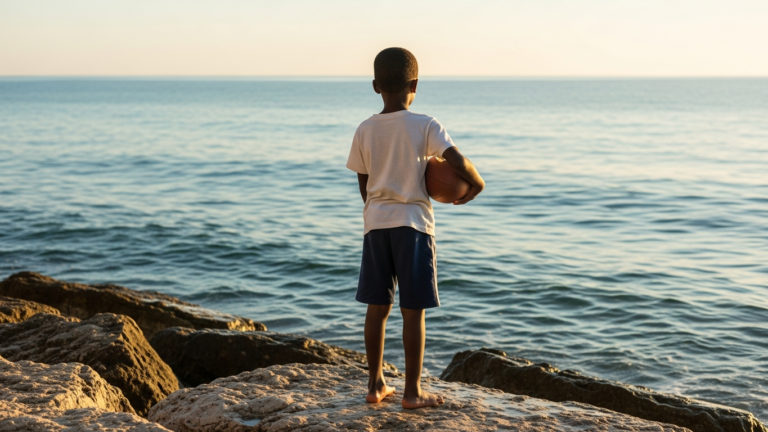
But someone gave him a ball. Not an official one — just a ball made of paper, shaped by kind hands and given freely. And somehow, in that small act of kindness, something in little Leo did not break. “From that day,” he would later write, “the ball has stayed in my heart and I have never stopped playing.”
That sentence alone is enough to stop you in your tracks. A child swallowed by tragedy, held together by the gift of play. It is the kind of story the Gospel seems to be speaking about when Jesus says, “Unless you turn and become like children, you will never enter the kingdom of heaven” (Matthew 18:3). There is a resilience in children that shames our adult tendency to give up on grace.
The Gateway to Europe — and a Meeting of Two Leos
Pope Leo XIV had come to Lampedusa for a pastoral visit organised around the ongoing humanitarian crisis in the Mediterranean. His first stop was the island’s migrant cemetery, where he laid a wreath of yellow and white flowers on graves marked with crosses fashioned from the splintered wood of wrecked boats. He paused especially over the grave of a child named Joussef — a moment that required no words.
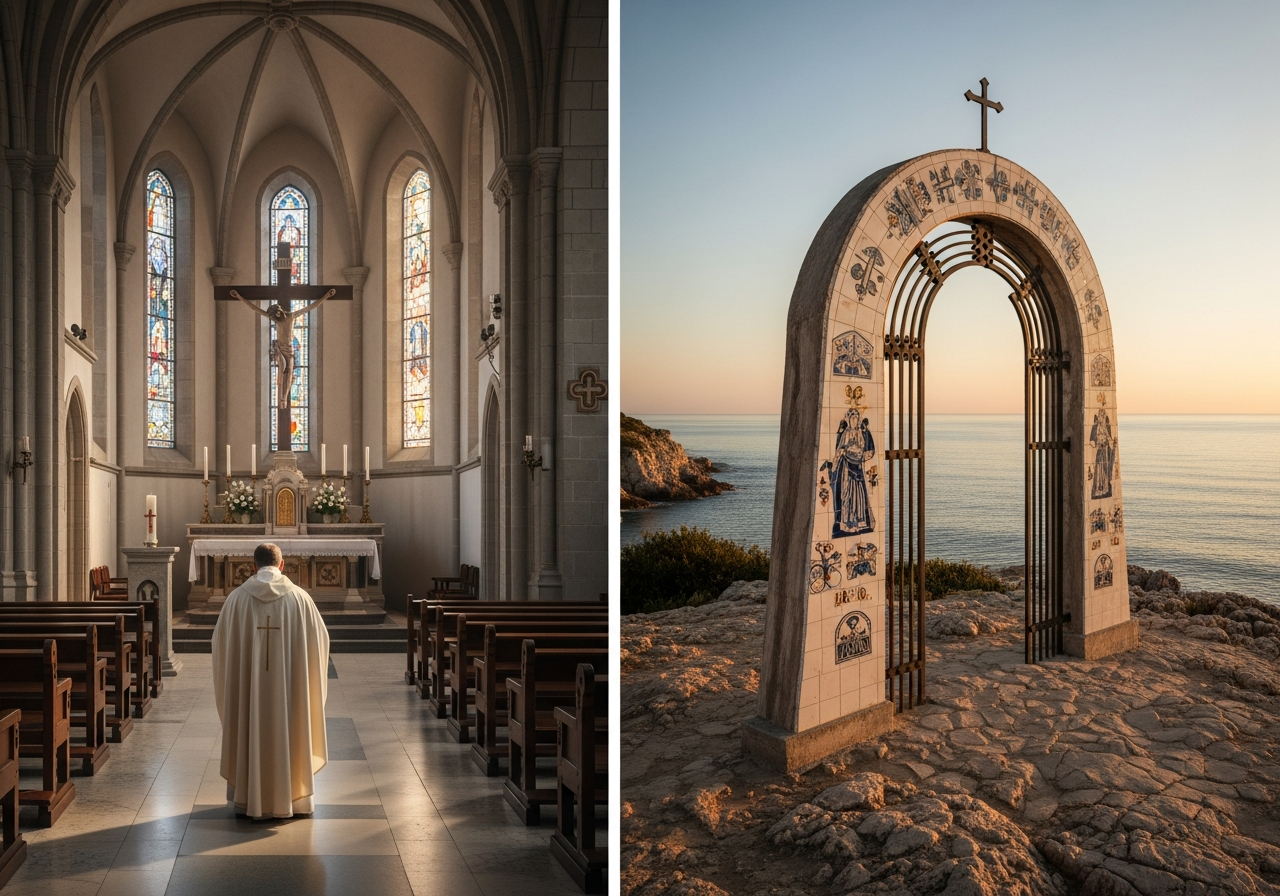
He then made his way to the Porta d’Europa — the Gateway to Europe — a striking 16-foot ceramic and iron arch designed by artist Mimmo Paladino and inaugurated in 2008 as a memorial to the migrants who never completed their journey. It stands on a rocky crag near the sea, with no door and no barriers, its surface catching the light of the sun and moon so that it can be seen by those arriving from across the water. It is a beacon. It is also a wound made visible in stone.
It was here, at this monument to so much sorrow, that Leo — now ten years old, now able to read and write and dream — walked up to the man who shares his name. He handed Pope Leo XIV a real football. And he gave him a letter.
“I hope with all my heart,” the boy wrote, “that this ball I am giving you now can reach another child and make them happy just like it did me.” He signed it simply: Grazie, Leo.
The Pope accepted it with visible emotion. He then spent time alone in prayer beside the sea.
A Miracle of Compassion on a Small Island
Later that morning, Pope Leo XIV celebrated Mass at the Arena sports ground before approximately 4,000 people, with the beloved image of Our Lady of Portosalvo displayed at the altar. In his homily, he reflected on the extraordinary generosity of Lampedusa’s permanent population — just 6,000 souls — who have, year after year, opened their arms to tens of thousands of desperate arrivals. He called their response a “miracle of compassion.”
He also issued a challenge. He warned against building what he called an “invisible wall” between tourists enjoying the island’s beauty and migrants arriving in search of safety. And he called on European leaders to move beyond treating migration as a recurring emergency and to work toward thoughtful, long-term, humane policies.
These are not merely political words. They are Gospel words. Scripture is unambiguous: “The stranger who sojourns with you shall be to you as the native among you, and you shall love him as yourself” (Leviticus 19:34). The Catholic Church has always held that the right to migrate and to seek safety is a fundamental human right, rooted in the dignity God has given every person without exception.
Pope Leo XIV concluded his homily by entrusting the migrants and the people of Lampedusa to the protection of Our Lady of Portosalvo, calling every Christian community to become “a safe haven” for those in need. If you are looking for ways to intercede for migrants and vulnerable people through prayer, our collection of Catholic Prayers includes powerful petitions for those in need.
Walking in the Footsteps of Francis
This visit carries a deliberate symbolic weight. Pope Francis — whose legacy Pope Leo XIV inherits — made Lampedusa the destination of his very first trip outside Rome in July 2013. He celebrated Mass at an altar constructed from a migrant boat and threw a wreath of flowers into the sea in mourning for the lost. Pope Francis famously called the Mediterranean “Europe’s largest cemetery.”
By choosing Lampedusa early in his own pontificate, Pope Leo XIV signals a clear continuity of pastoral concern. The suffering of migrants is not a footnote to the Church’s mission — it is close to its heart. The saints of the Church have always understood this. Many of our most beloved holy men and women were themselves refugees, exiles, or those who served the displaced. You can explore their stories in our guide to Catholic Saints.
What a Boy’s Letter Teaches the Church
In the end, it was not the papal homily or the political statements that defined this day — though those mattered deeply. It was a ten-year-old boy who once arrived with nothing, who was given a paper ball, who grew up holding that gift in his heart, and who then gave his most treasured possession to a stranger — asking only that it be passed on to another child who needs it.
That is the Gospel in miniature. That is what the Church is supposed to look like.
“I was a stranger and you welcomed me” (Matthew 25:35). Leo knows what it means to be that stranger. And now he knows what it means to be the one who welcomes. At ten years old, he has lived both sides of that verse.
If you wish to deepen your prayer life for the vulnerable and for our world’s most forgotten people, consider taking up the Rosary as a daily intercession — offering each decade for those at sea, in camps, or far from home.
A Closing Prayer
Lord Jesus, You Yourself were a refugee in Egypt, carried by anxious parents into a foreign land. Look with mercy today on all who cross dangerous waters in search of safety and dignity. Bless the little ones who arrive alone. Bless those who offer them shelter, food, and a simple ball made of paper. May Your Church be, in every nation and in every community, a true safe haven for the poor and the stranger. We entrust all migrants and refugees to the tender care of Our Lady, Star of the Sea. Amen.
Frequently Asked Questions
Why did Pope Leo XIV visit Lampedusa?
Pope Leo XIV visited Lampedusa to draw attention to the ongoing humanitarian crisis in the Mediterranean, where thousands of migrants have lost their lives attempting to reach Europe. The visit included prayer at the migrant cemetery, a stop at the Porta d’Europa memorial, and a Mass celebrating the island community’s extraordinary compassion.
Who is the boy named Leo who gave the Pope a football?
Leo is a ten-year-old boy who arrived on Lampedusa a decade ago as a young child, having lost his mother during the Mediterranean crossing. He grew up on the island and, during Pope Leo XIV’s visit, presented the Pope with a football and a handwritten letter expressing his hope that the ball would bring joy to another child in need.
What is the Porta d’Europa in Lampedusa?
The Porta d’Europa, or Gateway to Europe, is a 16-foot ceramic and iron arch created by artist Mimmo Paladino and inaugurated in 2008. It stands on the southwestern tip of Lampedusa as a memorial to the migrants who have died in the Mediterranean. It has no door or barriers and is designed so its surface reflects sunlight and moonlight, making it visible from the sea.
How does the Catholic Church teach about migrants and refugees?
The Catholic Church firmly upholds the dignity of every human person and teaches that the right to migrate in search of safety and a better life is a fundamental human right. Scripture repeatedly calls believers to welcome the stranger (cf. Leviticus 19:34; Matthew 25:35), and the Catechism of the Catholic Church calls on nations to welcome immigrants to the extent they are able, while also emphasising the duty to show solidarity with the poor and vulnerable.