
As we continue our Lenten journey, the Church calls us today to reflect on forgiveness and mercy. God’s mercy is endless, and He invites us to extend that same mercy to others.
Forgiveness is not always easy, but it is a powerful act of love that frees both the one who forgives and the one who is forgiven. During Lent, we are encouraged to examine our hearts, release grudges, and allow God’s grace to transform us.
Today is a beautiful opportunity to ask God for the grace to forgive as He forgives us.
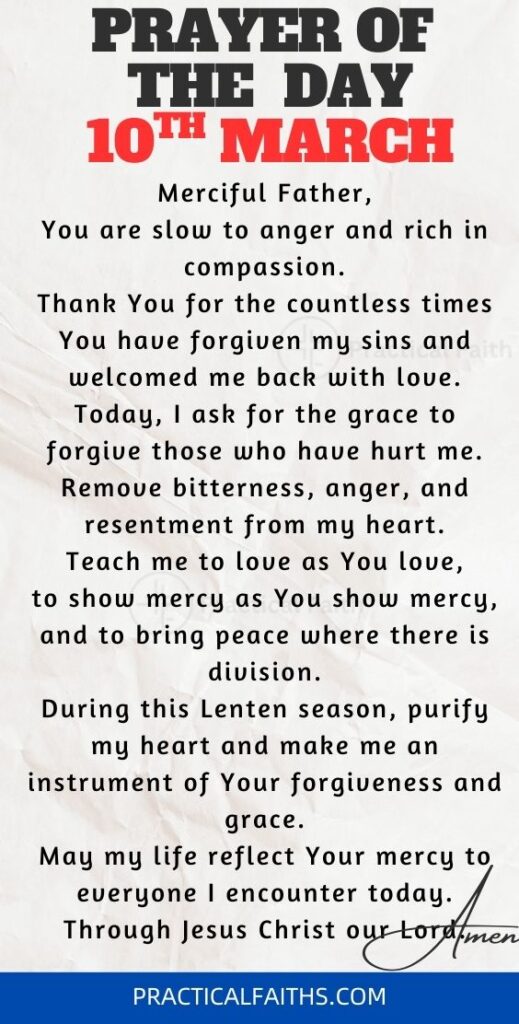
Prayer of the Day
Merciful Father,
You are slow to anger and rich in compassion.
Thank You for the countless times You have forgiven my sins and welcomed me back with love.
Today, I ask for the grace to forgive those who have hurt me.
Remove bitterness, anger, and resentment from my heart.
Teach me to love as You love,
to show mercy as You show mercy,
and to bring peace where there is division.
During this Lenten season, purify my heart and make me an instrument of Your forgiveness and grace.
May my life reflect Your mercy to everyone I encounter today.
Through Jesus Christ our Lord.
Amen.
Supporting Bible Verse
Be merciful, just as your Father is merciful.
— Luke 6:36
Mass Readings of the Day
First Reading
Daniel 3:25, 34–43
Azariah prays to God from the fiery furnace, asking for mercy on behalf of the people of Israel. Despite their sins, he trusts in God’s compassion and pleads for forgiveness.
Key Message:
True repentance opens the door to God’s mercy.
Responsorial Psalm
Psalm 25:4–5, 6–7, 8–9
“Remember your mercies, O Lord.”
The psalm is a prayer asking God to guide us in His truth and remember us with mercy rather than according to our sins.
Gospel
Matthew 18:21–35
Peter asks Jesus how many times he must forgive someone who sins against him. Jesus responds, “Not seven times but seventy-seven times,” and tells the parable of the unforgiving servant.
Key Message:
We must forgive others because God has forgiven us.
Saint of the Day
St. John Ogilvie
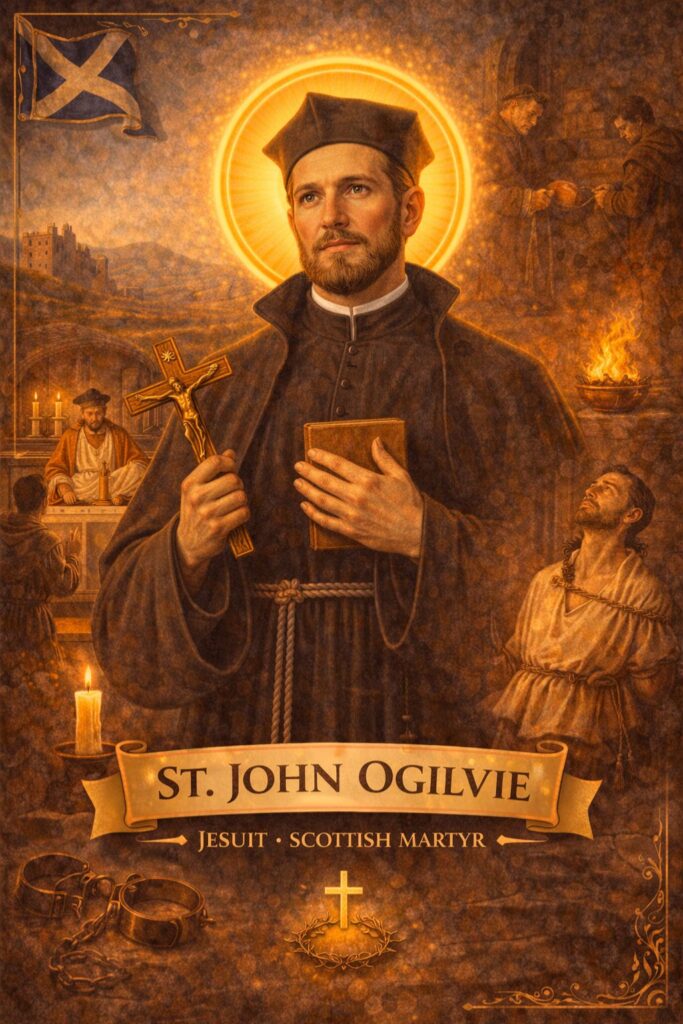
St. John Ogilvie was born in 1579 in Scotland into a noble Protestant family during a time when Catholicism was heavily persecuted.
As a young man, John traveled across Europe for his education. During his studies, he encountered the teachings of the Catholic Church and became deeply moved by the truth of the faith. After much prayer and reflection, he converted to Catholicism at the age of 17.
Determined to serve God, he joined the Jesuit Order and became a priest. But his greatest desire was to return to Scotland to minister secretly to Catholics who were suffering persecution.
In 1613, he returned to Scotland in disguise and began secretly celebrating Mass, hearing confessions, and strengthening the faith of persecuted Catholics.
Eventually, he was betrayed, arrested, and imprisoned. Authorities demanded that he deny the authority of the Pope and accept the king as the head of the Church.
John refused.
He endured months of brutal interrogation and torture, yet he remained steadfast in his faith.
Finally, in 1615, he was executed for refusing to renounce his Catholic beliefs. His last words were prayers for forgiveness for those who condemned him.
He was canonized in 1976 by Pope Paul VI and is remembered as one of Scotland’s great martyrs.
His life is a powerful witness to courage, faith, and loyalty to Christ.
10 Facts About St. John Ogilvie
- He was born in 1579 in Scotland.
- He grew up in a Calvinist Protestant family.
- He converted to Catholicism at age 17.
- He joined the Society of Jesus (Jesuits).
- He secretly returned to Scotland to minister to persecuted Catholics.
- He celebrated Mass in secret because Catholic worship was illegal.
- He was betrayed and arrested by authorities.
- He endured torture and interrogation for months.
- He was executed in 1615 for refusing to renounce his faith.
- He was canonized in 1976 by Pope Paul VI.
Daily Reflection
The courage of St. John Ogilvie reminds us that faith sometimes requires sacrifice.
Even in moments of fear or difficulty, God gives us the strength to stand for truth.
St. John Ogilvie, pray for us.