
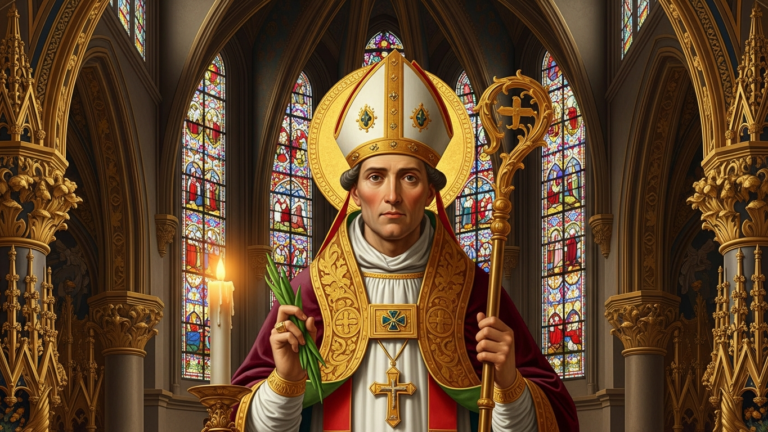
If you have ever wondered who the saint of July 8 feast day is, prepare to meet one of the most courageous missionaries in the history of the Church. Saint Killian was an Irish bishop who left everything he knew, crossed the sea and mountains of Europe, and gave his life for the truth of the Gospel. His story is not dusty history. It is a living challenge to every Catholic who wants to follow Christ without counting the cost.
Saint of July 8 Feast Day
The Church celebrates the feast day of Saint Killian on July 8 every year. Killian was a seventh-century Irish bishop and martyr, venerated alongside his companions Colman and Totnan, who were slain with him in Würzburg, Germany, around the year 689 AD.
Killian is often called the “Apostle of Franconia,” the region of what is now central Germany, because he was largely responsible for bringing Christianity to that area. The Church honours him not only as an evangelist who planted the faith in foreign soil, but as a martyr who refused to compromise that faith even when his life was threatened.
His feast day is celebrated with particular solemnity in Würzburg, where the magnificent Cathedral of Saint Killian stands as a monument to his legacy. Catholics around the world look to him as a patron of bold witness and steadfast fidelity. He is proof that the fire of Irish monastic missionary zeal truly did set Europe ablaze for Christ.
The Life of Saint Killian
Killian was born in Ireland around 640 AD, most likely in the province of Connacht. He grew up in the rich tradition of Irish Celtic monasticism, a movement that produced some of the most fearless missionaries the world has ever seen. From a young age, he felt a burning call not simply to live a holy life in Ireland, but to carry the Gospel to people who had never heard it.
Around 686 AD, Killian set out with eleven companions, including the priest Colman and the deacon Totnan. They made their way to Rome, where Pope Conon gave Killian episcopal consecration and sent him out as a missionary bishop to the Germanic lands. This was not a comfortable assignment. Franconia was rough territory, spiritually and physically, and the work was hard.
Killian and his companions settled in Würzburg and began preaching with remarkable success. The local duke, Gozbert, was moved by Killian’s words and converted to Christianity. It seemed as though the mission was taking root beautifully. But Killian was not a man who preached one thing and stayed quiet about another. He noticed that Gozbert’s marriage to Geilana, the widow of his own brother, was unlawful according to Church teaching. He told the duke plainly, citing the same moral law that had cost John the Baptist his head when he confronted Herod. As Mark 6:18 records, John told Herod, “It is not lawful for you to have your brother’s wife.” Killian followed the same path.
Gozbert was willing to end the marriage, but Geilana was not willing to lose her position. While the duke was away on a military campaign, she ordered the assassination of Killian, Colman, and Totnan. The three were murdered in cold blood around 689 AD. Their bodies were buried in secret, along with their sacred vestments and a copy of the Gospels. That Gospel book was later miraculously recovered, and it remains one of the great treasures of Church history, known today as the Killian Gospels, housed in Würzburg.
Killian’s death did not silence the faith he had planted. If anything, it watered it. The Church spread through Franconia in the years that followed, and Killian was quickly venerated as a martyr.

Saint Killian’s Patronage and Intercession
Saint Killian is the patron saint of Würzburg and the wider Franconia region of Germany. He is also invoked as a patron of those suffering from rheumatism and joint pain, a tradition rooted in the many healing miracles attributed to his intercession throughout the medieval period.
More broadly, Catholics turn to Saint Killian when they need courage to speak the truth in difficult situations. He is a powerful intercessor for missionaries, evangelists, and anyone who feels called to proclaim the faith in hostile or indifferent environments. Parents who are trying to raise children in the faith, priests who must deliver hard truths from the pulpit, and laypeople who face pressure to stay silent about their beliefs all have a friend and advocate in Killian.
His intercession is also sought by those discerning a vocation to missionary life, and by anyone who feels called to leave comfort behind in service of the Gospel.
A Prayer to Saint Killian
O glorious Saint Killian, fearless apostle of Franconia and martyr for the truth of Christ, I come to you today with a heart that sometimes trembles where yours stood firm. You left your homeland, your comfort, and finally your very life, all for love of God and souls. I ask for your intercession now.
Pray for us, Saint Killian, that we may find the courage to speak the truth with charity, even when it costs us something. Pray for us, that we may be bold in our faith and never ashamed of the Gospel. Intercede for all missionaries, for the persecuted Church, and for those who are sick and suffering.
Help me to trust, as you did, that no sacrifice made for Christ is ever wasted. May your example inspire me to live my faith without compromise and without fear. Saint Killian, martyr and apostle, pray for us. Amen.
What Saint Killian Teaches Us Today
Saint Killian lived the words of Saint Paul in Romans 1:16: “I am not ashamed of the gospel: it is the power of God for salvation to every one who has faith.” He was not ashamed. Not in foreign lands. Not in front of a powerful duke. Not when his life was on the line.
In a culture that increasingly pressures Catholics to keep their faith private, Killian’s witness is urgent. He reminds us that authentic love sometimes requires saying the difficult thing, and that the Gospel cannot be parcelled out selectively. We take the parts we like and quietly ignore the rest only at our spiritual peril.
This week, consider where you have been tempted to stay silent about your faith. Ask Saint Killian for one act of courage: one honest conversation, one quiet but clear witness. That is how the faith spread across Europe. One brave person at a time.
The Catechism (CCC 2471) reminds us that bearing witness to the truth is a moral duty. Killian bore that witness completely. We are called to do the same, in whatever form our particular life demands.
Related Catholic Resources
Deepen your faith with these guides on Practical Faiths:
→ Catholic Prayers
→ How to Pray the Rosary
→ Daily Mass Readings
Frequently Asked Questions
Who is the saint of July 8?
The saint of July 8 is Saint Killian, a seventh-century Irish bishop and martyr. He evangelised the Franconia region of Germany alongside his companions Colman and Totnan, and all three were martyred around 689 AD for defending Church teaching on the sanctity of marriage.
When is Saint Killian’s feast day?
Saint Killian’s feast day is celebrated on July 8. This date is observed throughout the universal Church calendar and with special solemnity in Würzburg, Germany, where he served as a missionary bishop and where his remains are enshrined in the cathedral that bears his name.
What is Saint Killian the patron saint of?
Saint Killian is the patron saint of Würzburg and the Franconia region of Germany. He is also traditionally invoked by those suffering from rheumatism and joint ailments, and he is a powerful patron of missionaries, evangelists, and all who must speak difficult truths in fidelity to the Gospel.
How do I pray to Saint Killian?
You can use the original prayer provided in this article, or simply speak to Saint Killian in your own words. Ask for his intercession with confidence, especially for courage in your faith, strength in difficulty, and healing. As with all saints, we ask them to pray with us and for us before God, just as we ask friends to pray for us here on earth.
What miracles are attributed to Saint Killian?
The Church records a strong tradition of healing miracles attributed to Saint Killian’s intercession, particularly relating to rheumatism and joint diseases. The miraculous recovery of the Killian Gospels, buried with him at his martyrdom and later found intact, was itself regarded as a sign of divine providence. His tomb in Würzburg became a major pilgrimage site throughout the medieval period, with numerous healings reported by pilgrims who venerated his relics.