If you’ve ever lain awake at 3 a.m., chest tight with worry and mind racing with fears you can’t silence, you are not alone — and the Catholic Church has something deeply consoling to offer you. The patron saint of anxiety is a real, recognised figure in Catholic tradition, and turning to saintly intercession is not merely pious sentiment: it is a powerful, time-honoured practice rooted in the Church’s teaching on the Communion of Saints. Let’s explore who this patron saint is, why the Church commends her to those who suffer, and how you can draw on the full treasury of Catholic faith to find genuine peace.
Who Is the Patron Saint of Anxiety? Meet St. Dymphna
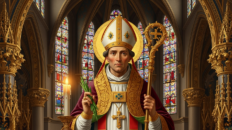
The principal patron saint of anxiety recognised by the Catholic Church is St. Dymphna (also spelled Dympna), a seventh-century Irish martyr whose story is one of profound suffering, courageous faith, and miraculous healing. According to tradition, Dymphna was the daughter of a pagan Irish chieftain and a devout Christian mother. After her mother’s death, her father’s grief twisted into a dangerous obsession, and Dymphna — still a teenager who had consecrated her virginity to God — fled to Belgium with her spiritual director, St. Gerebern. Tracked down near the town of Gheel, she was martyred rather than submit to evil. The Church soon recognised miraculous cures of mental and nervous disorders at her shrine, and pilgrims suffering from anxiety, depression, epilepsy, and other neurological conditions flocked to Gheel for centuries.
Her feast day is celebrated on May 15. What makes St. Dymphna particularly compelling as an intercessor is not simply tradition but the extraordinary witness of Gheel itself: the Belgian town that grew up around her shrine became one of the first communities in history to offer compassionate, family-based care for the mentally ill — a genuine civilisational fruit of her intercession. The Catechism of the Catholic Church (CCC 956) teaches that the saints “do not cease to intercede with the Father for us” and that their intercession “is their most exalted service to God’s plan.” Turning to St. Dymphna is therefore not superstition but an act of faith in the living Body of Christ.
St. Dymphna is also named alongside St. Benedict Joseph Labre and St. John of God as patrons of those suffering mental illness and anxiety. Each brings a different charism: St. John of God founded hospitals and showed that care for the suffering mind is a corporal work of mercy, while St. Benedict Joseph Labre lived with severe spiritual desolation and scrupulosity — making him a uniquely empathetic intercessor for those crushed by anxious, obsessive thoughts.
What Scripture Says About Anxiety — and Why It Matters
The Catholic Church does not dismiss anxiety as a moral failing or a simple lack of faith. Human beings are body-soul composites, and anxiety can arise from temperament, trauma, neurological factors, or spiritual desolation — often all at once. At the same time, scripture offers a profoundly hopeful word to those who suffer.
St. Paul, writing from prison — a man who knew acute personal danger — urged the Philippians: “Have no anxiety about anything, but in everything by prayer and supplication with thanksgiving let your requests be made known to God. And the peace of God, which passes all understanding, will keep your hearts and your minds in Christ Jesus.” (Philippians 4:6–7). Notice that Paul does not say “feel no anxiety” — he offers a path through it: prayer, supplication, thanksgiving, and surrender to God.
Our Lord himself addressed the anxious heart directly in the Sermon on the Mount: “Therefore do not be anxious about tomorrow, for tomorrow will be anxious for itself. Let the day’s own trouble be sufficient for the day.” (Matthew 6:34). This is not a rebuke but a gentle reorientation — an invitation to live in the present moment where God’s grace actually meets us. St. Padre Pio, himself a man of immense suffering, summarised this perfectly: “Pray, hope, and don’t worry.”
The First Letter of Peter adds another dimension: “Cast all your anxieties on him, for he cares about you.” (1 Peter 5:7). The Greek verb translated “cast” is vivid — it means to throw, to hurl, as though we are literally tossing our burdens onto Christ’s shoulders. This is not passive resignation; it is an active, repeated act of trust.
Practical Catholic Ways to Cope With Anxiety Every Day
Knowing who the patron saint of anxiety is gives us a powerful intercessor — but Catholic tradition offers a whole toolkit of practices that work together to bring peace to an anxious mind and soul.
1. The Rosary. The rhythmic, meditative repetition of Hail Marys has a well-documented calming effect on the nervous system, and its mysteries anchor the mind in the life of Christ. Our Lady of Guadalupe, Our Lady of Lourdes, and countless Marian apparitions have repeatedly urged the faithful to pray the Rosary — especially in times of distress. You can learn how to pray it with our guide at How to Pray the Rosary.
2. Frequent Confession and the Eucharist. Anxiety is often entangled with guilt, shame, or a subtle sense of being cut off from God. Regular Confession restores the soul’s peace objectively, not merely emotionally. The Eucharist, as the Catechism teaches (CCC 1392), “preserves, increases, and renews the life of grace received at Baptism” — it is medicine for the wounded soul.
3. Lectio Divina with anxiety-related scripture. Slowly praying through Psalm 23, Psalm 46, or Philippians 4 allows God’s Word to penetrate beneath anxious thoughts and speak to the heart at a deeper level.
4. Seek professional help without guilt. The Church is clear: pursuing medical and psychological treatment for anxiety is not a lack of faith. The Catechism (CCC 2288) affirms that care for health is a moral duty. Invoke St. Dymphna, then make the appointment.
Explore more Catholic Prayers and discover the stories of more intercessors in our guide to Catholic Saints.
A Prayer to St. Dymphna for Anxiety and Inner Peace
Good St. Dymphna, great wonder-worker in every affliction of mind and body, I humbly implore your powerful intercession with Jesus through Mary, the Health of the Sick. I pray that through your compassion and your special patronage, I may receive the grace I need to overcome the anxiety and fear that troubles my heart. Teach me, as you learned in your own suffering, to cling to God alone and to trust entirely in His Providence. May the peace of Christ, which surpasses all understanding, guard my heart and my mind. Amen.
Related Catholic Resources
Deepen your faith with these guides on Practical Faiths:
→ Catholic Prayers
→ Catholic Saints
→ How to Pray the Rosary
Frequently Asked Questions
Who is the official Catholic patron saint of anxiety?
St. Dymphna is the primary patron saint of anxiety, mental illness, and nervous disorders. She was a seventh-century Irish martyr whose shrine in Gheel, Belgium became famous for miraculous healings of mental and neurological conditions. Her feast day is May 15. St. John of God and St. Benedict Joseph Labre are also invoked by those suffering from anxiety and mental health struggles.
Is it okay for Catholics to struggle with anxiety — does it mean a lack of faith?
Absolutely not. Anxiety can be caused by neurological, psychological, and spiritual factors, and the Church recognises this complexity. Even great saints like St. Thérèse of Lisieux and St. John of the Cross experienced periods of intense spiritual darkness and interior anguish. The Catechism affirms that seeking medical and psychological help for mental health conditions is a morally responsible act, fully compatible with deep faith.
How do I pray to the patron saint of anxiety?
You can pray to St. Dymphna simply and directly — tell her your troubles in your own words and ask for her intercession before God. You can also use a formal novena to St. Dymphna, which is nine days of prayer traditionally made before her feast on May 15 or at any time of need. Combining this with the Rosary and frequent reception of the sacraments deepens the prayer’s power and fruitfulness.
What other Catholic prayers help with anxiety?
Beyond the prayer to St. Dymphna, Catholics have long found peace through the Rosary, the Chaplet of Divine Mercy (which focuses on trust in God’s mercy), the Liturgy of the Hours (especially Compline, the Church’s night prayer), and slow, meditative reading of Psalms 23, 34, and 46. St. Padre Pio’s simple motto — “Pray, hope, and don’t worry” — itself functions as a short prayer and mantra for anxious moments.