Let us pause in the quiet of this day, to lift our hearts in praise and petition to our loving God. May the Word we hear sustain us, and may the example of the saints encourage us to live in faith, hope, and charity.
Prayer of the Day
A Prayer for Salvation
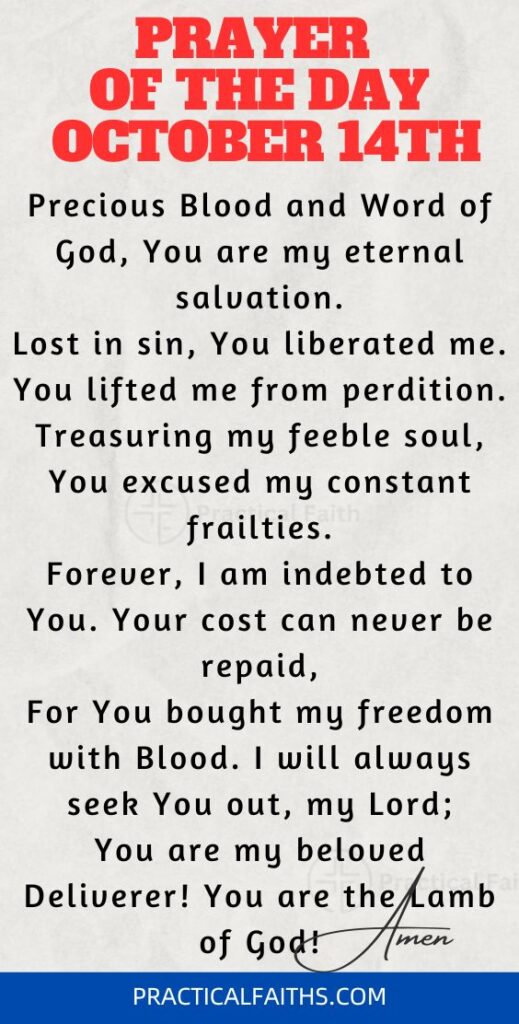
Precious Blood and Word of God, You are my eternal salvation.
Lost in sin, You liberated me. You lifted me from perdition.
Treasuring my feeble soul, You excused my constant frailties.
Forever, I am indebted to You. Your cost can never be repaid,
For You bought my freedom with Blood. I will always seek You out, my Lord;
You are my beloved Deliverer! You are the Lamb of God!
Amen.
Mass Readings of the Day
(Tuesday of the Twenty-Eighth Week in Ordinary Time)
First Reading: Romans 1:16-25
“I am not ashamed of the gospel, for it is the power of God for the salvation of everyone who has faith.”
Responsorial Psalm: Psalm 19:2-3, 4-5
“The heavens proclaim the glory of God.”
Gospel: Luke 11:37-41
After Jesus enters to dine with a Pharisee, He reproves the guests’ concern for outward cleanliness while their hearts are unclean. He calls them fools: “Did not he who made the outside make the inside also? But as to what is within, give alms, and behold, everything will be clean for you.”
In addition, for the Optional Memorial of St. Callistus I, the Church suggests alternate readings from 1 Peter 5:1-4, with the responsorial “Here I am, Lord; I come to do your will.”
Saint of the Day : Saint Callistus I, Pope and Martyr

Saint Callistus I’s story is one of extraordinary transformation — from slavery and hardship to the highest office in the Church.
Born in Rome during the late second century, Callistus began his life as a slave in the household of a Christian master. He was entrusted with managing funds collected from fellow believers, but through misfortune and mismanagement, the money was lost.
Desperate to escape punishment, Callistus fled, but he was soon captured and sentenced to hard labor in the mines of Sardinia — a punishment often reserved for the most disgraced.
In what can only be described as divine providence, Christian patrons interceded on his behalf and secured his release. Broken in body but renewed in faith, Callistus returned to Rome, where Pope Zephyrinus recognized his potential and ordained him a deacon.
The pope entrusted him with overseeing the Christian cemetery along the Appian Way, which later became known as the Catacombs of Callistus — one of the most important burial sites for early Christians.
When Zephyrinus died around the year 217, Callistus was elected Bishop of Rome, becoming the 16th pope. His papacy was marked by compassion and a deep understanding of human weakness. He was known for his mercy and forgiveness, welcoming back repentant sinners who had fallen away and reconciling converts from schismatic groups. This stance, though rooted in the Gospel’s call to mercy, was met with fierce opposition from stricter theologians, most notably Hippolytus, who accused Callistus of leniency and theological error.
Despite the criticism, Callistus remained steadfast in his conviction that the Church must be a refuge for sinners and a place of reconciliation. His leadership defended orthodox faith against heresies while emphasizing God’s infinite mercy. His life came to a tragic yet holy end around 222 A.D., when he was martyred during a local uprising, reportedly thrown into a well.
The Church later honored his sacrifice, and his relics were moved to the Basilica of Santa Maria in Trastevere in Rome — a church he was said to have founded or restored. Today, Saint Callistus I is remembered not only as a pope and martyr but also as a symbol of redemption — a man who rose from disgrace to sanctity, embodying the transforming power of God’s mercy.
10 Facts about Saint Callistus I
- From slavery to the papacy — Callistus began life as a slave in Rome before rising to become Bishop of Rome (Pope).
- Managed church finances — He was put in charge of church funds and collections, which later got lost or mismanaged, leading to conflict.
- Flight and punishment — After the financial trouble, he fled but was captured, thrown into the sea, or forced into harsh penalties including the mines.
- Ransom and rescue — Christian supporters raised funds to free him from the mines and return him to Rome.
- Deacon of the catacombs — As deacon, he administered the Christian cemetery on the Appian Way, which later bore his name.
- Pope from ca. 217 to 222 — He succeeded Pope Zephyrinus and led the Church for about five years.
- Emphasis on mercy — He favored inclusion of repentant sinners and converts, a stance that drew criticism from strict theologians.
- Contested by Hippolytus — Hippolytus, who opposed him, wrote much of the surviving accounts of Callistus’ life (though as a rival).
- Martyrdom — He died as a martyr in Rome (c. 222), allegedly thrown into a well during a riot or uprising.
- Relics translated — His remains were later moved in the 9th century to Santa Maria in Trastevere.