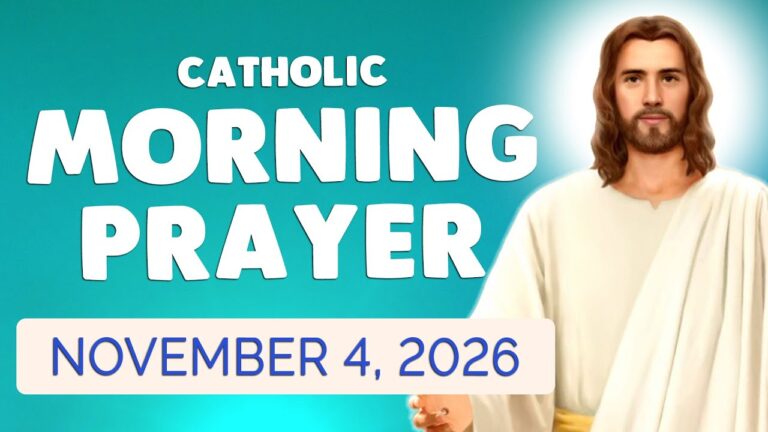
As we arrive at this day, the Church invites us to reflect on reform, holiness, and service rooted in truth.
Today’s readings urge us to live authentically and courageously, and the saint of the day reminds us that even positions of authority can be humbly transformed into instruments of grace.
May our hearts be open to God’s merciful call and our lives be renewed in faith
Prayer of the Day
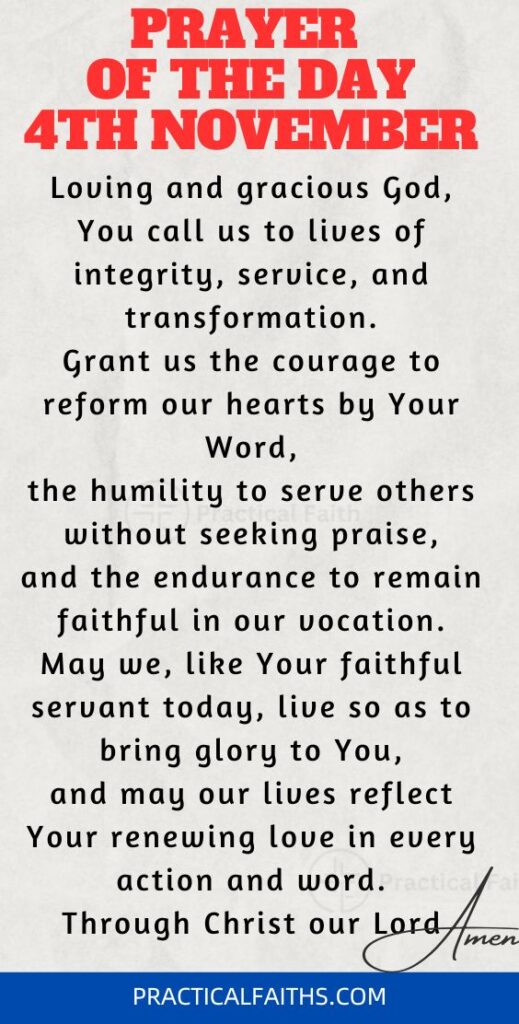
Loving and gracious God,
You call us to lives of integrity, service, and transformation.
Grant us the courage to reform our hearts by Your Word,
the humility to serve others without seeking praise,
and the endurance to remain faithful in our vocation.
May we, like Your faithful servant today, live so as to bring glory to You,
and may our lives reflect Your renewing love in every action and word.
Through Christ our Lord.Amen
Mass Readings of the Day
First Reading: Romans 11:29–36
“For the gifts and the call of God are irrevocable.”
Responsorial Psalm: Psalm 69:30–31, 33–34, 36–37
“For God is my helper, and the Lord is the upholder of my life.”
Gospel: Luke 14:12–14
Jesus teaches: “When you give a banquet, invite the poor, the crippled, the lame, the blind; blessed are you because they cannot repay you.
Saint of the Day
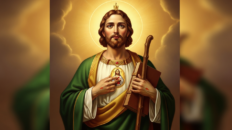
St. Charles Borromeo (1538–1584)
Feast Day: November 4
Charles Borromeo was born on October 2, 1538, into the noble Borromeo and Medici families in northern Italy. At a young age he was elevated through Church offices, becoming a cardinal by his early twenties. Despite his position and privilege, Charles was deeply moved by the needs of the Church during the time of the Protestant Reformation and the Council of Trent
When he became Archbishop of Milan in 1564, he embarked on a daring mission of reform: establishing seminaries for priests, promoting catechism for the laity, personally visiting the sick and poor, and living a life of radical charity and simplicity.
During the plague of 1576 and famine in his diocese, Charles walked the streets barefoot, ministered to the dying, and borrowed money to feed tens of thousands daily. His reforms and personal sacrifice made him a pivotal figure in the Catholic Counter-Reformation. He died on November 3, 1584, and was canonized on November 1, 1610.
Charles’s story teaches us that true leadership in the Church is built on service, sacrifice, and fidelity to Christ’s mercy — even when the burdens weigh heavily.
10 Facts About St. Charles Borromeo
- He was born on October 2, 1538, at the castle of Arona near Lake Maggiore, Italy.
- His family was one of the most influential in Lombardy — his mother was a Medici and his uncle became Pope Pius IV.
- He was appointed a cardinal in 1560 while still in his twenties.
- In 1564 he became Archbishop of Milan and began sweeping reforms in clergy education, liturgy, and Catholic life.
- He established seminaries in Milan and the surrounding region to ensure proper priestly formation.
- During the plague and famine of 1576 in Milan, he personally cared for the sick, walked barefoot in the streets, and arranged relief for tens of thousands.
- He played a key role in guiding the final sessions of the Council of Trent, supporting its implementation in his diocese.
- He refused to lead a luxurious life despite his noble status, choosing poverty, simplicity, and personal austerity.
- He died on November 3, 1584 at the age of 46 after years of intense labor and sickness.
- Canonized on November 1, 1610, he is the patron saint of bishops, catechists, seminarians, and spiritual directors.