
Today we commemorate St. Bruno of Cologne, the founder of the Carthusian order. He left a life of academic prestige to seek solitude, prayer, and radical fidelity to God.
His story challenges us to consider what counts as true devotion, and whether we are willing to surrender comforts in pursuit of deeper union with the Lord.
Prayer of the Day
O God, who by the preaching of Blessed Bruno have made your people mindful of heavenly things, grant that, by his intercession, we may strip away what is earthly and reach those things that are eternal.
Through our Lord Jesus Christ, your Son, who lives and reigns with you in the unity of the Holy Spirit, God, for ever and ever.Amen

Mass Reading of the Day
Since October 6 sometimes falls under a Sunday or a normal weekday (depending on the liturgical calendar), the readings may vary. But often the Twenty-Seventh Sunday in Ordinary Time is applied. For example:
- First Reading: Genesis 2:18-24 — the account of the creation of woman and the institution of marriage.
- Responsorial Psalm: Psalm 128:1-2, 3, 4-5, 6 — “May the Lord bless us all the days of our life.”
- Second Reading: Hebrews 2:9-11 — Christ made lower than the angels for a time, to bring many children to glory.
- Gospel: Mark 10:2-16 (or 10:2-12) — Jesus teaches about marriage, divorce, and welcoming children.
Reflection (brief): These readings remind us that God’s design is for deep unity — in marriage, in family, and between God and humanity through Christ. As Bruno chose solitude and union with God, we too are called to deeper communion, whether in community or in hiddenness.
Saint of the Day: St. Bruno of Cologne
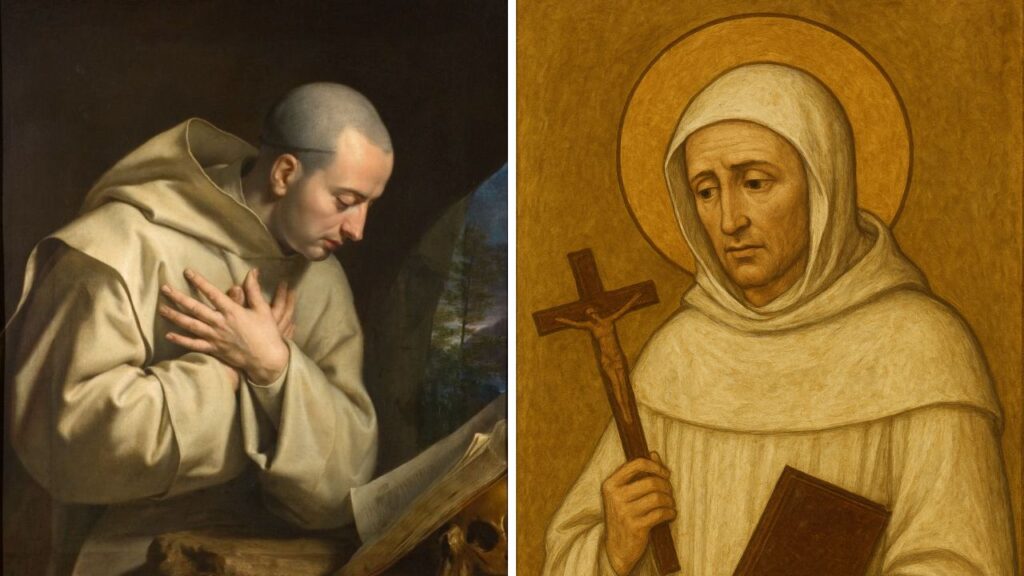
Bruno was born around 1030 in Cologne, Germany. As a young man, he pursued scholarship and became a noted teacher in Rheims, France. He served as chancellor of the archdiocese, influenced church affairs, and stood up for reform amid corruption.
Yet Bruno felt a deeper call. He resisted offers of high ecclesial office and instead sought a life of prayer and solitude. With a few companions, he retreated to the isolated region called Chartreuse, founding a secluded monastery whose austerity and contemplative ethos gave birth to the Carthusian Order.
In that rugged solitude Bruno and his fellow monks lived a combination of hermit and community life: times of silent prayer, manual work, and sacred reading. Bruno later spent his final years in the wilderness of Calabria, Italy, where he died on October 6, 1101.
His vision shows us that holiness may lie not in noise and prestige, but in radical detachment and an unshakable gaze toward God.
10 Facts about St. Bruno
- Born circa 1030 in Cologne, Germany.
- Educated and taught in Rheims; known for his learning.
- Served as chancellor of the Archdiocese of Rheims.
- Opposed corruption among the clergy and refused advancement to higher offices.
- Founded the Carthusian Order (1084), known for its extreme austerity and solitary prayer.
- Lived a hybrid life: monks in the order lived solitary lives but came together for liturgy.
- Refused to become a bishop even when offered; he preferred silence and withdrawal.
- Died on October 6, 1101, in Calabria, Italy.
- Though never formally canonised by a typical process, Pope Clement X extended his feast to the universal Church in 1674.
- Patronage/associations: he is sometimes invoked by those seeking contemplative life, reform, and in times of spiritual dryness; also considered a figure of strong witness against corruption
YOU MAY ALSO LIKE
Meet the Missionary Brothers Who Sacrificed for the Faith
When You Feel Unsafe — Remember You Already Have a Bodyguard
When You Feel “Too Small” — Turn to St. Thérèse,