Today the Church reminds us through Scripture that God is a God of peace, authority, and justice. In Revelation, we see heaven worshipping the Lamb, while in Luke’s Gospel, Jesus weeps over Jerusalem — not out of anger, but love. He desires our conversion, our peace, and our full return to Him.
As we approach today’s readings, may our hearts be open to Christ’s mercy and attentive to the things that make for true peace.
Prayer of the Day
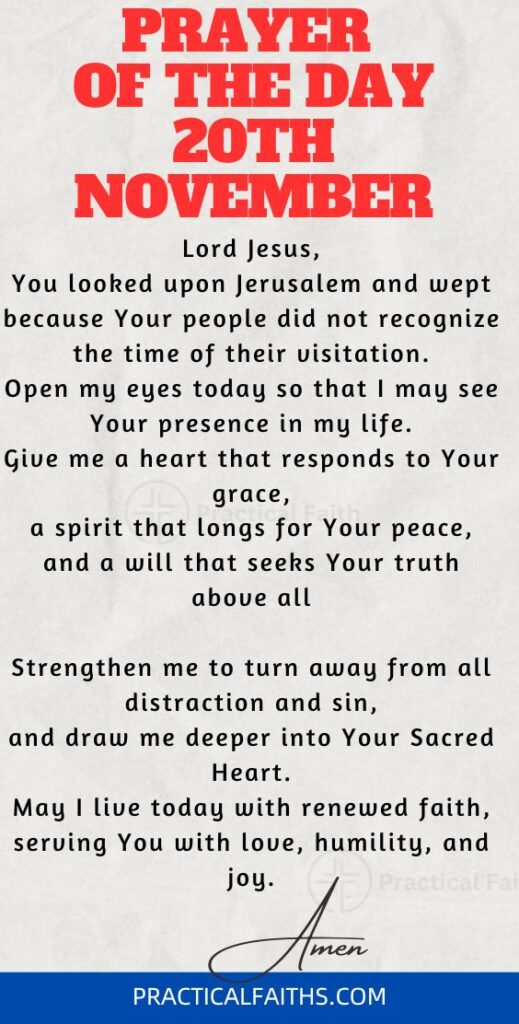
Lord Jesus,
You looked upon Jerusalem and wept because Your people did not recognize the time of their visitation.
Open my eyes today so that I may see Your presence in my life.
Give me a heart that responds to Your grace,
a spirit that longs for Your peace,
and a will that seeks Your truth above all.Strengthen me to turn away from all distraction and sin,
and draw me deeper into Your Sacred Heart.
May I live today with renewed faith,
serving You with love, humility, and joy.
Amen
Mass Readings of the Day (November 20)
First Reading — Revelation 5:1–10
John sees the scroll in God’s hand that no one can open — until the Lamb appears. Christ alone is worthy to open what no one else can, because by His blood He saved the world.
Responsorial Psalm — Psalm 149:1–2, 3–4, 5–6a, and 9b
“The Lord takes delight in His people.”
A psalm calling God’s people to praise Him with joy, song, and dance.
Gospel — Luke 19:41–44
Jesus weeps over Jerusalem.
Not because He is powerless.
But because the people do not recognize “the things that make for peace.”
He warns them that their rejection will bring destruction — a prophecy that came true in AD 70.
Saint of the Day: St. Rose Philippine Duchesne
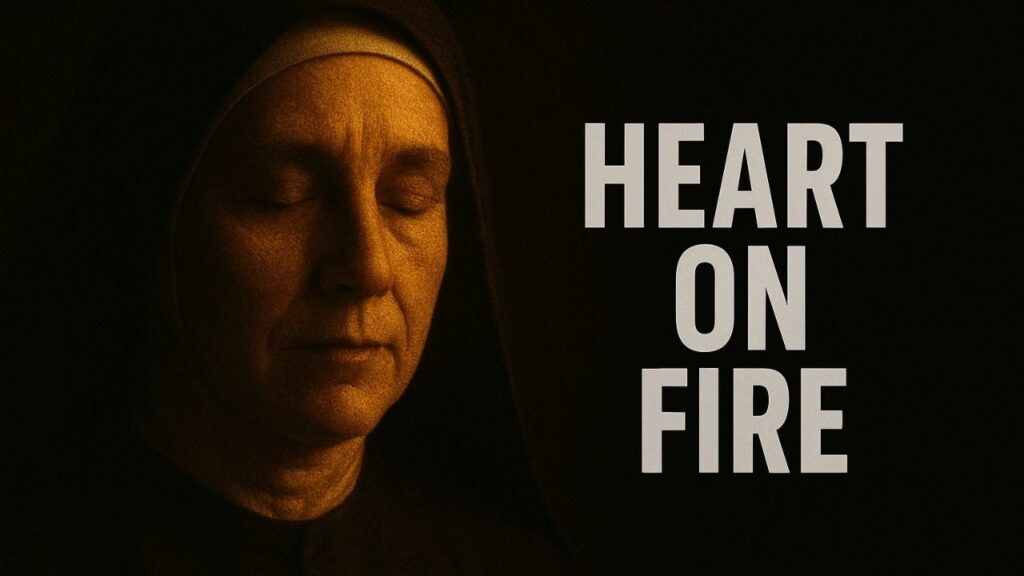
St. Rose Philippine Duchesne (1769–1852) was a courageous French missionary whose burning desire was simple:
to bring the love of Jesus to souls who had never heard His name.
Born into a wealthy family, she shocked everyone when she refused a comfortable life and instead entered a convent. When the French Revolution erupted, convents were destroyed — but Rose refused to stop serving. She risked her life secretly caring for the poor, teaching children, and helping persecuted priests.
After the Revolution, she felt an unmistakable call to serve in the New World. At age 49 — when most people slow down — she crossed the Atlantic, sailing for 11 weeks in brutal conditions. She landed in Louisiana and later Missouri, where she founded schools, including the first free school for girls west of the Mississippi.
Rose dreamed of working among Indigenous peoples, and late in life she finally did. The Potawatomi people — who loved her deeply — gave her the name:
**“Quah-kah-ka-num-ad”
❝The Woman Who Prays Always❞**
And it was true. Rose would kneel for hours, sometimes all night, interceding with a fierce love.
She died peacefully in 1852, leaving behind a legacy of courage, education, faith, and missionary zeal.
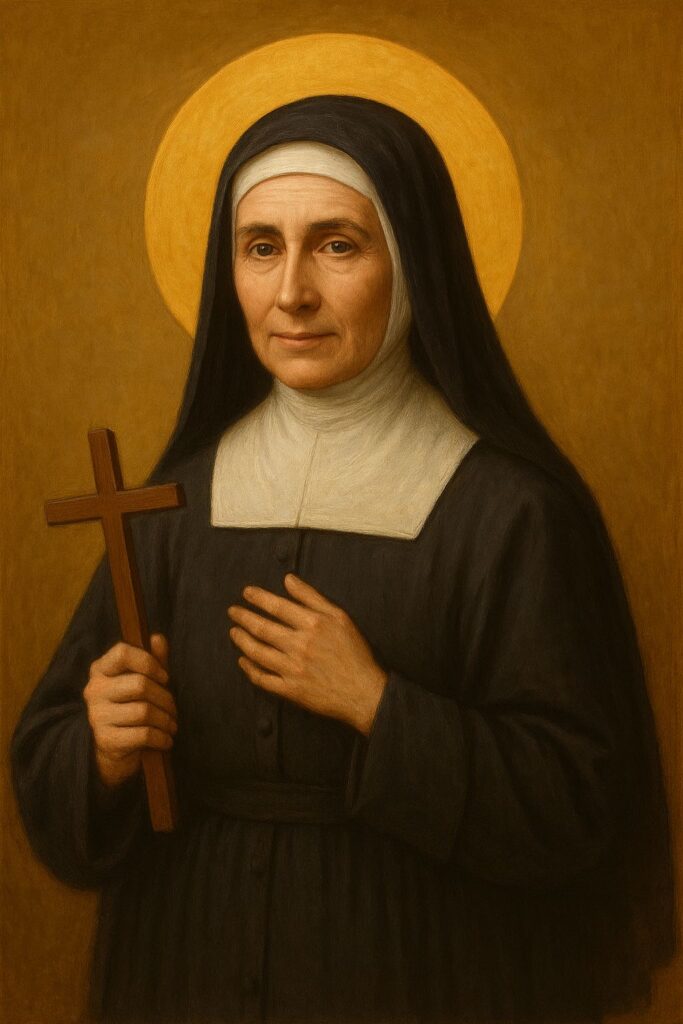
10 Facts About St. Rose Philippine Duchesne
- Born: August 29, 1769, in Grenoble, France.
- She entered the Visitation convent at age 19, against her family’s wishes.
- The French Revolution forced her out of religious life temporarily — but she continued serving in secret.
- After meeting St. Madeleine Sophie Barat, she joined the Society of the Sacred Heart.
- She sailed to America in 1818 at age 49, fulfilling her lifelong missionary dream.
- Founded the first Sacred Heart convent in the United States, located in Missouri.
- Opened the first free school for girls west of the Mississippi River.
- The Potawatomi honored her with the name:
“The Woman Who Prays Always.” - Known for intense prayer — kneeling for long hours, even in old age.
- Canonized in 1988 by Pope St. John Paul II.