Welcome to today’s mass reading for July 7, Tuesday of the Fourteenth Week in Ordinary Time. Every day the Church gives us a gift: a short set of scriptures chosen to form us, challenge us, and draw us deeper into friendship with God. Today’s readings are no exception. They carry a single, urgent heartbeat: God wants mercy, not performance. He wants you, not your polished exterior. Let’s walk through these readings together and see what they are saying to us right now, today.
Mass Reading July 7: Tuesday of the Fourteenth Week in Ordinary Time
July 7 falls in what the Church calls Ordinary Time, that long green season stretching from after Pentecost through to Advent. “Ordinary” doesn’t mean dull. The word comes from the Latin ordinalis, meaning numbered or ordered. These are the weeks the Church uses to teach us the fundamentals of discipleship, one Gospel passage at a time.
In Year C of the weekday cycle, we are reading through the Book of Hosea in the First Reading and working our way through the Gospel of Matthew. The liturgical colour is green, a symbol of growth, life, and hope. Today the Church places before us a bracing challenge: do we serve God from the heart, or from habit? Do we follow Jesus immediately when He calls, or do we hedge our bets?
This is not a theoretical question. It lands right in the middle of ordinary Tuesday life.
First Reading: Hosea 8:4-7, 11-13
The prophet Hosea speaks for God to a people who have drifted badly. They have multiplied altars, but not to worship. They go through the motions of religion while their hearts are far away. God says plainly: “They offer sacrifice to me and eat the meat, but the Lord does not accept them” (see Hosea 8:13, RSVCE).
This is one of the most uncomfortable passages in the entire Old Testament because it sounds so familiar. How often do we go through the external forms of faith without bringing our actual selves? We might attend Mass, say the prayers, perform the rituals, but leave our hearts locked in the car park. Hosea names this plainly: it is a kind of idolatry. We are worshipping the practice of religion rather than the living God who stands behind it.
Saint John of the Cross taught that God is not satisfied with anything less than the whole person. The Catechism (CCC 2112) reminds us that idolatry is not just bowing to statues. It is putting anything in the place that belongs to God, including our own religious comfort and routine. Hosea’s words are a mercy, not a condemnation. They pull us back from a slow drift before it becomes a disaster.
The practical invitation here is simple. Before Mass today, or before any prayer, take one honest moment and ask: am I bringing my real self here, or a polished version? God already knows the difference. He just wants you to know it too.
Responsorial Psalm: Psalm 115 (114):3-10
The psalm response today carries the refrain: “The house of Israel trusts in the Lord”. Read the full psalm at Psalm 115, RSVCE.
The psalm contrasts the living God with idols that cannot speak, see, hear, or act. Its tone is almost darkly comic, then deeply consoling. The God we worship is alive. He sees you. He hears you. He acts in history. The idols of our age, whether they are money, status, approval, or distraction, cannot do any of this. They are impressive, but mute. Trust, the psalm tells us, belongs to the Lord alone. That is the ground under our feet as we hear today’s other readings.

Gospel: Matthew 9:32-38
In today’s Gospel from Matthew 9:32-38 (RSVCE), two remarkable things happen in quick succession, and then Jesus steps back and gives us the lens to understand both of them.
First, a mute man who is possessed is brought to Jesus. Jesus drives out the demon. The man speaks. The crowds are amazed and say: “Never was anything like this seen in Israel”. The Pharisees, however, see the same miracle and say: “He casts out demons by the prince of demons.” Same event. Radically different responses. One group sees grace. The other sees threat.
This contrast sits right at the heart of Matthew’s Gospel. The Pharisees are not stupid men. They are learned, devout, and genuinely concerned with faithfulness to the Law. But they have built such a tight system of interpretation that when God himself shows up doing something new, they cannot receive it. Their religion has become a prison, not a door.
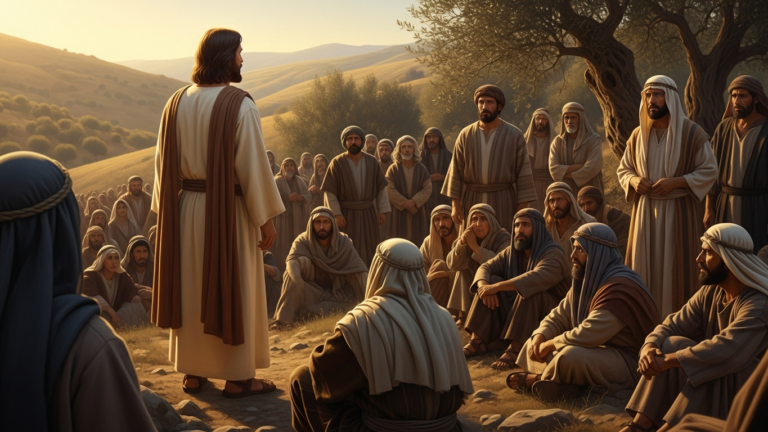
Then comes the verse that Matthew uses as a hinge for everything that follows. Jesus travels through all the towns and villages, teaching, proclaiming the kingdom, and healing every disease. And then Matthew records something extraordinary: “When he saw the crowds, he had compassion for them, because they were harassed and helpless, like sheep without a shepherd” (Matthew 9:36, RSVCE).
The Greek word translated “had compassion” is esplanchnisthe, a word so physical it almost embarrasses translators. It means his gut was wrenched. His insides moved. This was not a polite concern from a distance. This was visceral, whole-body love for people who were exhausted, leaderless, and lost.
That compassion is still the engine of the Church today. The Catechism (CCC 1, 27) opens by reminding us that God desires to draw every human being into communion with himself. The mission of the Church is not primarily an institution maintaining itself. It is a direct extension of this gut-wrenching compassion of Christ for the crowd in front of him.
Jesus then turns to his disciples and says: “The harvest is plentiful, but the labourers are few; pray therefore the Lord of the harvest to send out labourers into his harvest” (Matthew 9:37-38, RSVCE). Notice the order. He does not immediately commission them. He tells them to pray first. This is important. The response to seeing human need is not immediately to do more. It is to pray, to place the need before God, to ask Him to raise up the right people at the right time. Action flows from prayer. Effectiveness flows from surrender.
Saint Teresa of Calcutta built her entire ministry on this passage. She taught her sisters that they could not give what they did not have, and that what they needed above all was an encounter with Christ in prayer before they encountered Christ in the poor. That is not a pious footnote. That is the practical method Jesus himself gives us in this Gospel.
What does this mean for ordinary Tuesday life? It means that when you see a person who is harassed and helpless, whether that is a colleague under impossible pressure, a friend drowning in grief, or a stranger who simply looks lost, the first response God asks for is not a solution. It is compassion, the kind that actually moves something in you. And then prayer. Ask God to send exactly the right help, and remain open to the possibility that you are the one being sent.
A Prayer for Today’s Mass Reading
Lord Jesus, today you looked at the crowds and your heart broke open for them. Break my heart open too. Let me see the people around me as you see them: precious, tired, and longing for a shepherd. Forgive me for the times I have gone through the motions of faith while keeping you at arm’s length. Today I bring you my real self, not the polished version. Use my eyes, my hands, and my voice as instruments of your compassion. And where the harvest is great and the labourers are few, Lord of the harvest, send me. I am willing. Make me ready. Amen.
Living Today’s Gospel: Practical Application
Today’s readings are not abstract. They reach into very ordinary moments. Here are three concrete ways to carry them through the rest of your day.
First, pray before you act. When you encounter a problem or a person in need today, pause for thirty seconds before responding. Ask God what he sees, and what he wants you to do. This is exactly the pattern Jesus models in the Gospel: see, feel compassion, pray, then act.
Second, examine your religious habits. Take Hosea’s challenge seriously today. Choose one regular prayer practice, perhaps grace before meals, or a brief examination of conscience at night, and deliberately bring your full attention to it. Say the words as if you mean them, because God is actually there.
Third, notice one person who seems harassed or helpless today. You do not need to fix their situation. You simply need to see them the way Jesus saw the crowd. A kind word, a genuine question, a moment of real attention: these are small acts of the same compassion that moved Christ’s heart in the Gospel.
Related Catholic Resources
Deepen your faith with these guides on Practical Faiths:
→ Catholic Prayers
→ Catholic Saints
→ How to Pray the Rosary
Frequently Asked Questions
What are today’s Catholic Mass readings for July 7?
The mass reading for July 7 in the weekday lectionary includes the First Reading from Hosea 8:4-7, 11-13, the Responsorial Psalm 115 (114), and the Gospel from Matthew 9:32-38. This is the Tuesday of the Fourteenth Week in Ordinary Time.
What is the theme of today’s Mass reading?
The central theme today is authentic faith over empty religious performance. Hosea challenges hollow worship. The psalm calls us to trust the living God over lifeless idols. And the Gospel shows us Christ moved to his core by human need, calling his disciples first to pray, then to labour in his harvest. Together they call us to bring our whole selves to God.
How do I follow along with the daily Mass readings?
The easiest ways are through the USCCB website at usccb.org, the Magnificat app, the iBreviary app, or by picking up a daily missal at your local Catholic bookshop. You can also follow along right here at Practical Faiths, where we publish reflections on the daily Mass readings throughout the year.
What is the liturgical colour for the Fourteenth Week of Ordinary Time?
The liturgical colour for Ordinary Time, including the Fourteenth Week, is green. Green represents growth, life, and hope. It signals the season of active discipleship, when the Church reflects on the teachings of Christ and how they shape everyday Christian living.