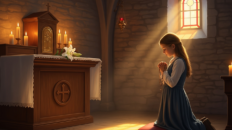
As we enter into this new day, let us quiet our hearts and open ourselves to the Lord’s voice. May God’s Word strengthen us, His grace sustain us, and the example of His saints walk with us on our journey toward holiness.
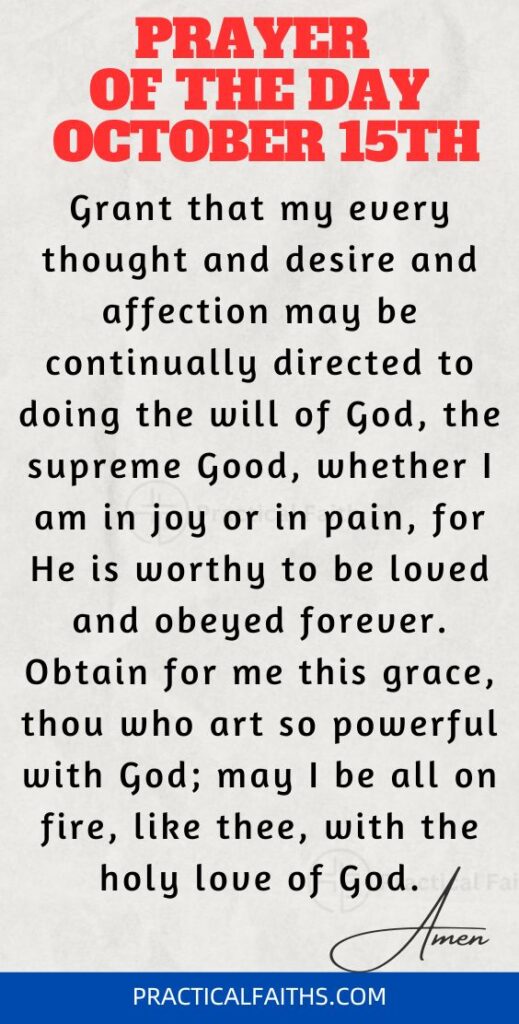
Prayer of the Day
Grant that my every thought and desire and affection may be continually directed to doing the will of God, the supreme Good, whether I am in joy or in pain, for He is worthy to be loved and obeyed forever. Obtain for me this grace, thou who art so powerful with God; may I be all on fire, like thee, with the holy love of God.
— (Prayer to St. Teresa of Ávila)
Mass Readings of the Day
(Obligatory Memorial of St. Teresa of Ávila, Virgin & Doctor of the Church)
First Reading: Romans 2:1-11
“Therefore you have no excuse, whoever you are, when you judge others; for in passing judgment on another you condemn yourself, because you, the judge, do the very same things.”
Responsorial Psalm: Psalm 62:2-3, 6-7, 9
“Lord, you give back to everyone according to his works.”
Alleluia Verse: John 10:27
“My sheep hear my voice; and I know them, and they follow me.”
Gospel: Luke 11:42-46
“Woe to you Pharisees, because you tithe mint, rue, and every herb, but you neglect justice and the love of God. These you ought to have done without neglecting the others… Woe to you lawyers also, because you load people with burdens hard to carry, and you yourselves do not touch them with one of your fingers.”
Saint of the Day
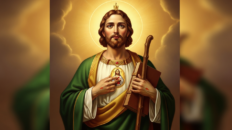
St. Teresa of Ávila (also known as St. Teresa of Jesus)
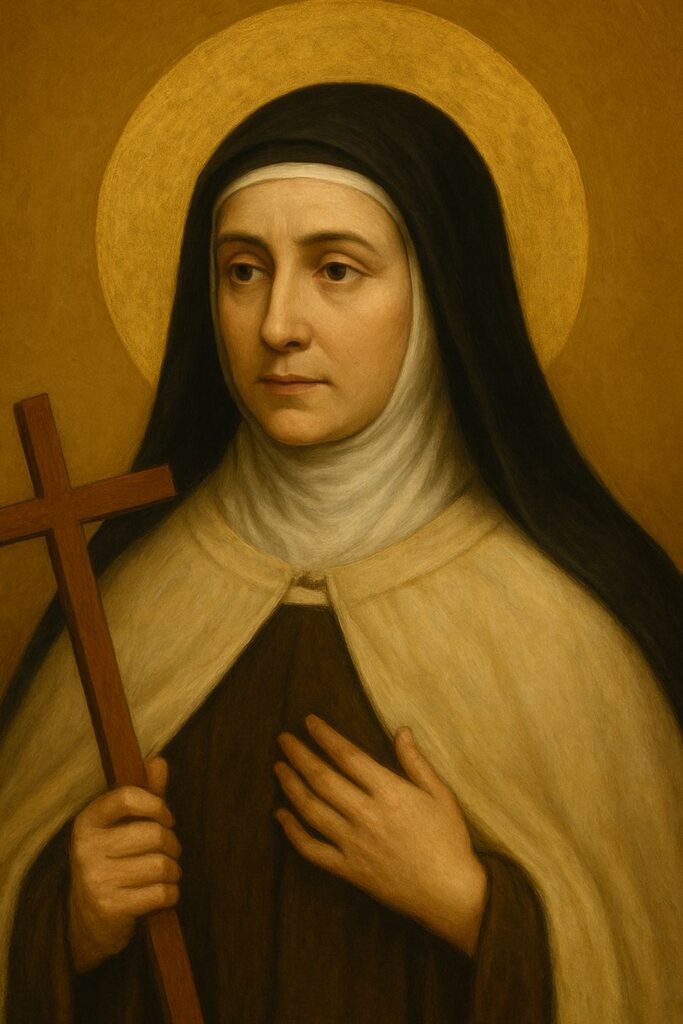
St. Teresa of Ávila was born Teresa Sánchez de Cepeda y Ahumada in 1515 in Ávila, Spain. She entered the Carmelite convent and, over time, experienced deep spiritual growth, mystical visions, and a call to reform.
Teresa noticed that many Carmelite houses had grown lax in discipline. Motivated by her interior life and devotion to mental prayer, she initiated a reform to return to stricter observance — founding convents that lived in greater austerity, simplicity, and more intense contemplative prayer.
Her friendship with St. John of the Cross further advanced the Discalced Carmelite movement (meaning “shoeless” Carmelites) for both men and women.
Her writings — especially The Interior Castle (El Castillo Interior) and The Way of Perfection — remain classics of Christian spirituality, guiding countless souls along the interior path to God.
She died on October 4, 1582 (though due to the calendar reform, her feast is observed on October 15), and was canonized in 1622. In 1970, Pope Paul VI named her a Doctor of the Church — one of the first women ever so honored — in recognition of her profound writings on prayer and mysticism.
Her life stands as a model of interior union with God, courageous reform, humility, and trust in the Spirit even amid suffering and opposition.
10 Facts about St. Teresa of Ávila
- She was born in 1515 in Ávila, Spain.
- Her given name was Teresa Sánchez de Cepeda y Ahumada.
- She entered the Carmelite convent in her youth and struggled through periods of illness and inner dryness.
- She felt called to reform the Carmelite order and founded the first convent of the reform (St. Joseph’s) in 1562.
- Over her lifetime she established many new “Discalced” (shoeless) Carmelite houses across Spain.
- She was a dear friend and spiritual companion to St. John of the Cross, who assisted in the male branch of the reform.
- Her greatest mystical works include The Interior Castle and The Way of Perfection, still widely read today.
- In recognition of her theological depth, she was named a Doctor of the Church in 1970 by Pope Paul VI — one of the first women so named.
- She suffered from chronic health issues but persevered in her mission despite opposition, criticism, and personal suffering.
- She is the patron saint of Spanish Catholic writers and those who suffer from headaches.