A thousand prayers do not equal one act of abandonment. I ask God for what I need. A lot. Sometimes I feel like I run through a continuous strain of “Lord, please give me this” or “I need that” from morning to night. My needs sometimes spill over into conversations with friends too, when I […]
A thousand prayers do not equal one act of abandonment.
I ask God for what I need. A lot. Sometimes I feel like I run through a continuous strain of “Lord, please give me this” or “I need that” from morning to night. My needs sometimes spill over into conversations with friends too, when I ask them to pray on my behalf for a variety of intentions.
Although I try not to let my own needs be the exclusive focus of my prayer, they’re a big part of the reality. So much so that sometimes, as I hear my own thoughts and petitions, I wonder if I sound too needy. I wonder if I am too needy.
We’re all needy: It’s part of the human condition. Making peace with that reality and learning how to respond to it is an important step in recognizing who God wants to be for us.
While our neediness might make us feel a little vulnerable and weak, God sees it differently. He knows our needs before we know them ourselves. Our needs glorify him, giving him the opportunity to overwhelm us with his goodness and mercy.
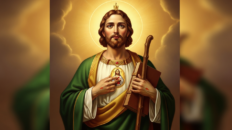
Don Dolindo Ruotolo, a Capuchin friar who lived from 1882-1970, deeply understood the relationship between our neediness and God’s goodness.
Ordained at the age of 23, Don Dolindo spent his life in prayer, sacrifice and service. He heard confession, gave spiritual guidance and cared for those in need. For a time, Don Dolindo served as spiritual director to the more widely known saint, Padre Pio. When some pilgrims from Naples, where Don Dolindo resided, went to Padre Pio in Pietrelcina, Padre Pio responded: “Why do you come here, if you have Don Dolindo in Naples? Go to him, he’s a saint!”
The simple friar is becoming most known for his spirituality of surrender. Well aware of the depth of human weakness and neediness, Don Dolindo saw this as a way of fostering continual union with God.
While inviting us to continually bring our worries and concerns to the Lord, Don Dolindo teaches us that the focus doesn’t stay on our needs. He encourages us to bring our needs to God and then be at peace, leaving God free to care for us in his wisdom. Don Dolindo tells us that the Lord has promised to fully take on all the needs we entrust to him. In the words of Jesus to Don Dolindo:
Why do you confuse yourselves by worrying? Leave the care of your affairs to me and everything will be peaceful. I say to you in truth that every act of true, blind, complete surrender to me produces the effect that you desire and resolves all difficult situations. (…)
A thousand prayers do not equal one act of abandonment; don’t ever forget it. There is no better novena than this:
O Jesus, I abandon myself to you. Jesus, you take over.
The many healings and favors obtained by people who went to Don Dolindo and followed his advice, as well as those that have been attributed to his intercession, give witness to the power of grace that can be unleashed through such abandonment to Divine Providence.
Read more: Confessions of a novena failure
Don Dolindo wrote what Our Lord revealed to him about divine abandonment from the perspective of Jesus addressing the soul. The prayer of surrender can be read in its entirety, or prayed in nine shorter segments as a daily novena.
I have been praying Don Dolindo’s novena regularly for almost a year now, and have found it to be not only a reminder of the importance of bringing my needs and worries to the Lord, but also a source of great consolation and encouragement.
Don Dolindo Ruotolo is currently a Servant of God; his cause for beatification is open.
The Novena of Abandonment: A Complete Surrender to God
The novena Father Cilento described — the 11-word prayer “Father, I abandon myself into Your hands; do with me what You will” — is drawn from a longer prayer by Blessed Charles de Foucauld, a French nobleman who converted to radical holiness after an encounter with Christ. His “Prayer of Abandonment” became the foundation of an entire spirituality.
“Father, I abandon myself into your hands; do with me what you will. Whatever you may do, I thank you: I am ready for all, I accept all. Let only your will be done in me, and in all your creatures. I wish no more than this, O Lord. Into your hands I commend my soul; I offer it to you with all the love of my heart, for I love you, Lord, and so need to give myself, to surrender myself into your hands, without reserve, and with boundless confidence, for you are my Father.”
Blessed Charles de Foucauld
Why Abandonment Prayer is So Powerful
The Prayer of Abandonment represents the highest form of Christian prayer: total trust in God’s wisdom and love, regardless of outcomes. This is not passivity or resignation — it is the active, faith-filled decision to trust that the God who loves us infinitely is fully capable of guiding our lives better than we can.
Saint John of the Cross wrote: “Abandon yourself to God and you will find that He will abandon Himself to you.” The spiritual exchange of abandonment is extraordinary: when we release our grip on our lives, God takes hold of them with infinite care.
How to Practice the Prayer of Abandonment Daily
Morning consecration: Begin each day with the simple prayer: “Father, I abandon myself into Your hands for this day.” Repeat it when anxiety, control issues, or fear arise throughout the day.
In specific situations: When facing a difficult decision, a health report, a relationship conflict — say “Father, I abandon this into Your hands.”
At night: End each day with the same surrender: “Lord, I place this day — its successes and failures — into Your hands. Do with me what You will.”
The Fruit of Abandonment
Those who practice the Prayer of Abandonment consistently report the same fruit: profound peace. Not the absence of difficulty, but the presence of God within difficulty. The peace that “passes all understanding” (Philippians 4:7) becomes accessible when we stop fighting to control what only God can control.
Father, I abandon myself into Your hands. Do with me what You will. Amen.







Add comment